Most engineering consultancies run their sales pipeline in one system, build proposals in a second and track project delivery in a third. The gap between winning work and delivering it profitably is where margin disappears, data gets re-keyed and decisions are made on outdated numbers. This article compares the best sales and project delivery software for engineers, with clear criteria around admin reduction, profitability and proposal-to-project continuity, so you can evaluate which platform fits your firm.
Proteus connects the full project lifecycle, from opportunity evaluation through proposals, delivery and invoicing, in one integrated system built specifically for engineering consultancies. Below you will find a structured comparison of six platforms, evaluation criteria and practical guidance on choosing the right fit.
Quick guide: 6 best sales and project delivery software for engineers
- Proteus: The best integrated sales and project delivery platform for engineering consultancies managing high-volume projects
- Deltek Vantagepoint: ERP with project accounting modules built around architecture and engineering firms
- Kantata: Professional services automation with resource management and project financials
- IFS Cloud: Enterprise asset and service management with project modules for large operators
- Oracle Primavera P6: Scheduling-focused project portfolio management for capital programmes
- Bentley ProjectWise: Document and design collaboration for infrastructure engineering teams
How we chose the best sales and project delivery software for engineers
Choosing project delivery software for an engineering consultancy is not the same as picking a generic task manager. Your firm charges out time, equipment and specialist resources against tight margins. The platform needs to reflect that reality from the first opportunity evaluation to the final invoice.
Here is what we looked for when evaluating each platform:
- Proposal-to-project continuity: Can you convert a won bid into a live project without re-entering WBS line items, rate cards and budgets?
- Real-time project controls: Does the platform calculate earned value, cost performance and forecast-at-completion automatically, or are you building those numbers offline?
- Engineering-specific cost structures: Can it handle multi-tiered rate tables for labour, equipment and software alongside multi-currency billing?
- Resource visibility: Does the platform show utilisation rates across offices and disciplines so you can plan capacity ahead of time?
- Integration with existing systems: Can it connect to your ERP, CRM and finance tools through documented APIs rather than requiring a full system replacement?
- Admin reduction: Does it automate routine workflows such as reporting, invoicing and timesheeting, reducing the administrative load on project managers?
- Data security and compliance: Does it meet ISO 27001 or equivalent standards for protecting sensitive project and financial data?
The 6 best sales and project delivery software for engineers
1. Proteus: Best overall sales and project delivery software for engineers
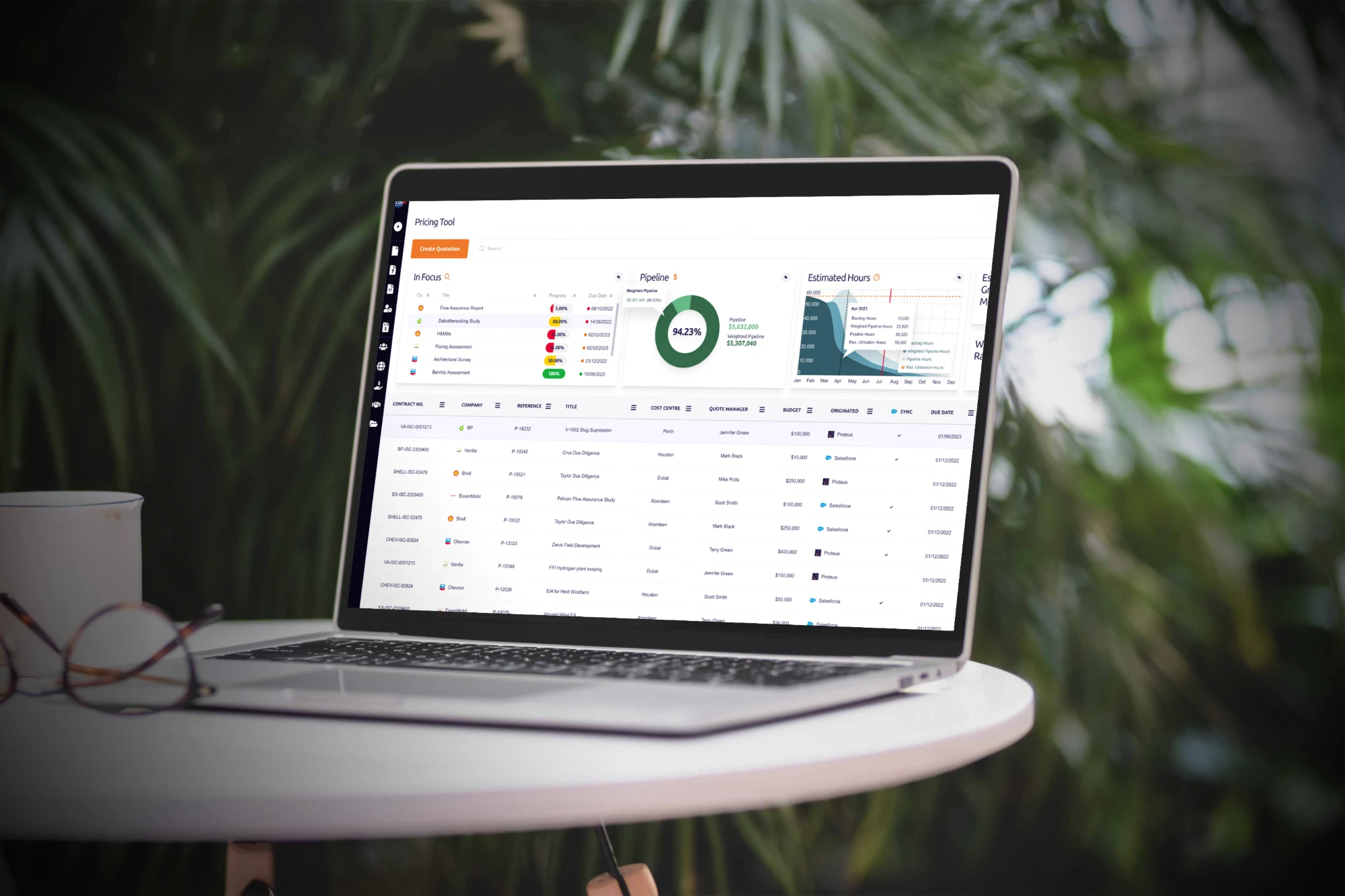
Proteus is an integrated sales and project delivery platform built by experienced project engineers who understand the operational realities of engineering consultancies. Where most platforms cover either sales or delivery, Proteus connects the entire project lifecycle in one system, from opportunity evaluation and bid management through proposals, resource planning, project tracking, project controls, forecasting and invoicing.
The platform is purpose-built for firms that charge out time, equipment and specialist resources. Proteus gives you a single source of truth for project data, replacing fragmented tools and disconnected workflows. Engineering consultancies internationally use Proteus to manage complex energy and infrastructure projects, reduce admin overhead and protect profit margins across every project stage.
What makes Proteus distinct is the proposal-to-project transition. When you win a bid, the approved WBS, rate cards and financial baselines convert directly into a live project structure with a single action. No duplicate data entry, no re-keying cost estimates, no risk of numbers drifting between systems.
Proteus features
- Bid evaluation and proposal management: Formalised bid/no-bid workflows, opportunity scoring and consistent proposal templates help you win the right work and price it accurately from the start
- Automated project controls: Real-time earned value metrics, SPI, VOWD, EAC and cost performance calculations update automatically as timesheets and expenses are logged, giving you live insight into project health
- Multi-currency project finance: Handle international projects with rate tables and invoicing in multiple currencies, all tracked in one system
- Resource planning and utilisation: View resource availability across offices and disciplines, identify capacity gaps early and optimise utilisation rates to protect margins
- Real-time dashboards and reporting: Configurable, role-based dashboards give project managers, directors and finance teams the data they need in the format they need it, updated in real time
- ERP and CRM integration: Proteus connects to your existing systems, such as SAP, Oracle, Workday and Salesforce, through documented APIs, adding project-specific capabilities without replacing your current tech stack
Proteus pros
- Full project lifecycle coverage from sales to invoicing in one integrated platform removes data gaps between departments
- Built by project engineers for consultancies, so workflows, terminology and cost structures are dynamic and are mapped neatly into Proteus
- Dedicated one-on-one customer success support with free onboarding consultation ensures fast adoption
What to consider with Proteus
- Designed specifically for consultancies utilising detailed work breakdown structures, so workflows may not suit organisations that rely heavily on Agile, exploratory, fluid or ad-hoc task tracking
- The depth of configuration options means your admin team should plan for an initial setup period to map your organisational structure, rate tables and approval workflows
- The platform is optimised for consultancies managing high volumes of shorter-duration projects rather than single multi-year mega-programmes
2. Deltek Vantagepoint: ERP with A&E project accounting
Deltek Vantagepoint is an ERP platform that includes project accounting, resource planning and CRM modules. It is used across architecture, engineering and consulting firms for financial management and project tracking. The platform consolidates HR, accounting and project data into one system.
Vantagepoint includes time and expense tracking, billing workflows and project dashboards. It is oriented toward firms that need an all-in-one ERP rather than a specialist project delivery tool.
Deltek Vantagepoint features
- Project accounting: Tracks revenue recognition, billing and work-in-progress reporting across project portfolios
- Resource planning: Shows staff availability and skills to help allocate people across projects
- CRM and pipeline management: Tracks business development activities and opportunities in the same platform
Deltek Vantagepoint vs Proteus
Pros:
- Combines project accounting, HR and CRM functions in a single ERP environment
- Includes revenue recognition and WIP reporting tailored for professional services
- Has a large installed base in the A&E sector with an established user community
How it differs from Proteus:
- The ERP approach means project delivery and sales features are one part of a broader system rather than the central focus
- Does not include automated proposal-to-project conversion with WBS and rate card carryover
- Implementation timelines tend to be longer due to the breadth of modules that need configuration
3. Kantata: PSA with resource management focus
Kantata offers professional services automation (PSA) that includes resource management, project financials and time tracking. It is positioned for IT and consulting firms that need to manage utilisation and project margins. Kantata tracks projects from staffing through to billing.
The platform includes predictive analytics for resource forecasting and integrates with third-party accounting tools. It does not include sales proposal or bid management modules specific to engineering workflows.
Kantata features
- Resource management: Matches team members to projects based on skills, availability and role requirements
- Project financials: Tracks budgets, actuals and margins at the project and portfolio level
- Time and expense tracking: Records billable and non-billable hours with configurable approval workflows
Kantata vs Proteus
Pros:
- Resource management and utilisation tracking are central to the platform
- Includes predictive analytics for forecasting staffing needs across projects
- Integrates with accounting platforms to connect project financials to broader finance processes
How it differs from Proteus:
- Oriented toward IT and general professional services rather than engineering consultancies specifically
- Does not include bid evaluation, proposal building or WBS-based cost estimation workflows
- Lacks industry-specific rate table structures for equipment, software licensing and multi-tiered labour rates
4. IFS Cloud: Enterprise asset management with project modules
IFS Cloud is an enterprise platform with modules spanning enterprise resource planning, enterprise asset management, field service and project management. It is used by large organisations in sectors like energy, aerospace and manufacturing.
The project management module includes cost tracking, scheduling and procurement. IFS is designed for operators and asset-heavy businesses rather than engineering consultancies running high volumes of client-facing projects.
IFS Cloud features
- Project cost management: Tracks project costs against budgets and contracts at the work order level
- Enterprise asset management: Manages physical assets, maintenance schedules and lifecycle performance
- Procurement and supply chain: Handles purchasing, supplier management and material tracking across projects
IFS Cloud vs Proteus
Pros:
- Covers asset management, service and project functions in one enterprise platform
- Includes procurement and supply chain modules for asset-heavy project environments
- Has a user base in energy and aerospace sectors with established industry templates
How it differs from Proteus:
- Project modules are part of a broader enterprise suite, not a standalone project delivery tool
- Does not include proposal management, bid evaluation or engineering-specific sales workflows
- Implementations typically require significant customisation and system integration work for consultancies
5. Oracle Primavera P6: Scheduling for capital programmes
Oracle Primavera P6 is a project portfolio management tool focused on scheduling, cost control and risk analysis for large capital programmes. It is widely used in construction, infrastructure and government projects for detailed CPM scheduling.
P6 handles complex scheduling dependencies and resource levelling. It does not include sales, proposal management or invoicing modules, so engineering firms using it typically pair it with separate tools for business development and financial management.
Oracle Primavera P6 features
- CPM scheduling: Creates and manages complex project schedules with dependencies, milestones and critical path analysis
- Resource levelling: Allocates resources across projects to balance workload and availability
- Portfolio management: Tracks multiple projects at the portfolio level with roll-up reporting and risk analysis
Oracle Primavera P6 vs Proteus
Pros:
- Scheduling capabilities are suited to large, complex programmes with thousands of activities
- Includes risk analysis and scenario modelling for capital programme planning
- Has an established user base in construction, government and infrastructure sectors
How it differs from Proteus:
- Focused on scheduling and does not cover the sales, proposal or invoicing stages of the project lifecycle
- Requires separate tools for business development, timesheeting, financial management and client billing
- Designed for mega-programme environments and does not scale down efficiently for consultancies managing many shorter-duration projects
6. Bentley ProjectWise: Document collaboration for infrastructure
Bentley ProjectWise is a collaboration and document management platform designed for infrastructure engineering teams. It manages design deliverables, CAD files and project documentation across multi-discipline teams working on roads, utilities and transport projects.
ProjectWise handles version control, access permissions and audit trails for engineering documents. It does not include project financial management, sales, proposal building or cost tracking modules.
Bentley ProjectWise features
- Document management: Stores, versions and tracks engineering documents, drawings and design files
- Design review workflows: Routes documents through review and approval cycles with audit trails
- Multi-discipline collaboration: Connects teams across offices and disciplines working on shared design deliverables
Bentley ProjectWise vs Proteus
Pros:
- Manages engineering documents, drawings and version control across large project teams
- Supports multi-discipline collaboration on design deliverables for infrastructure projects
- Integrates with Bentley’s wider infrastructure design software suite
How it differs from Proteus:
- Covers document collaboration only, not project financial management, cost tracking or invoicing
- Does not include sales pipeline, proposal management or bid evaluation capabilities
- Requires pairing with other platforms for cost control, resource planning and project delivery management
What should engineers look for when choosing project delivery software?
The first question is whether the platform handles the full arc from sales to delivery. According to the APM Salary and Market Trends Survey, 2025, 47% of respondents agree that AI is already having an impact on project management, which makes the underlying data foundation even more critical. Many tools focus on one stage, either scheduling, or accounting, or resource planning, and leave gaps that get filled with disconnected files and manual workarounds.
For engineering consultancies, the critical requirement is continuity. Your WBS, rate cards and cost baselines should flow from proposal to live project without being rebuilt. If they do not, you lose accuracy at the exact moment the project moves from planning to execution.
Look for real-time project controls that update automatically as timesheets and costs are logged. You should not need to export data into a separate file to calculate earned value or forecast at completion. The same applies to invoicing. If your project finance data lives in one system and your invoicing in another, reconciliation becomes a recurring overhead.
Why is proposal-to-project continuity important for engineering firms?
When a proposal wins approval, the cost estimates, resource plan and work breakdown already reflect what was agreed with the client. If those numbers have to be re-entered into a separate delivery tool, errors and discrepancies follow.
Proposal-to-project continuity means the financial baselines, team allocations and scope structure carry over automatically. This gives project managers an accurate starting point from day one, rather than spending the first weeks reconstructing what was already built during the bidding phase.
It also creates an auditable trail. You can trace any cost variance back to the original estimate, which is critical for project finance governance and client reporting. Proteus handles this conversion with a single action, preserving the WBS line items, rate tables and financial baselines exactly as they were approved.
Why Proteus is the best sales and project delivery software for engineers
Proteus addresses the core problem that most engineering consultancies face: the disconnect between winning work and delivering it profitably. Instead of stitching together separate tools for sales, proposals, project tracking and invoicing, Proteus gives you one integrated system built around how engineering firms actually operate.
The platform was developed by people from the energy industry for people working in the energy industry. That origin shows in the detail: WBS-based cost structures, multi-tiered rate tables, automated project controls calculations and real-time earned value metrics are not bolt-on features. They are how the system was designed from the start. Proteus gives your teams control, consistency, accuracy and visibility across the full project lifecycle.
If you are evaluating software for your engineering consultancy, request a demo to see how Proteus connects your sales and delivery workflows in one system.
FAQs about best sales and project delivery software for engineers
What is sales and project delivery software?
Sales and project delivery software connects business development, proposal management and project execution in one platform. Proteus, for example, covers the full project lifecycle from opportunity evaluation through proposals, tracking and invoicing, giving engineering consultancies a single source of truth for project data.
Why do engineering firms need integrated sales and delivery software?
When sales and delivery run on separate systems, data gets re-entered, cost estimates drift and margin visibility arrives too late. An integrated platform like Proteus carries WBS structures, rate cards and baselines from proposal to live project, keeping financials accurate from day one.
Can Proteus integrate with existing ERP and CRM systems?
Yes. Proteus connects to platforms such as SAP, Oracle, Workday and Salesforce through documented APIs. It adds project-specific capabilities to your existing digital ecosystem without requiring a full system replacement.
What types of engineering firms use Proteus?
Proteus is used by engineering consultancies, energy contractors and operator organisations managing complex projects across sectors including oil and gas, offshore wind, renewables and infrastructure. The platform is designed for firms that charge out time, equipment and specialist resources.
How does Proteus help improve project profitability?
Proteus tracks costs, hours and utilisation rates in real time across every project stage. Automated project controls calculations flag cost overruns and schedule variances early, giving project managers the data to intervene before margin erodes.